
The Ripples of Colonial Mentality Through History
Written by Eddy Gana
Lead, Non-Binary Chapter
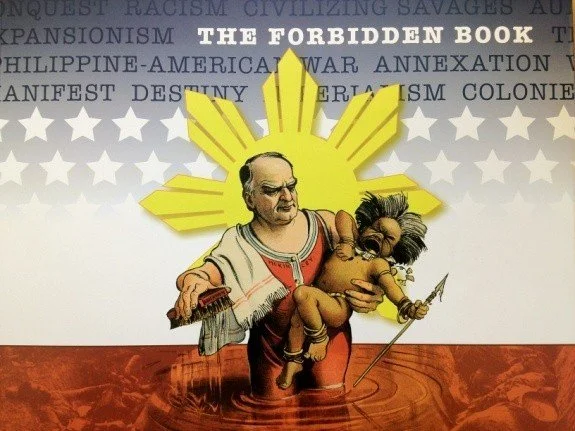
The Forbidden Book: The Philippine-American War in Political Cartoons
Book by Abe Ignacio
The Ripples of Colonial Mentality Through History
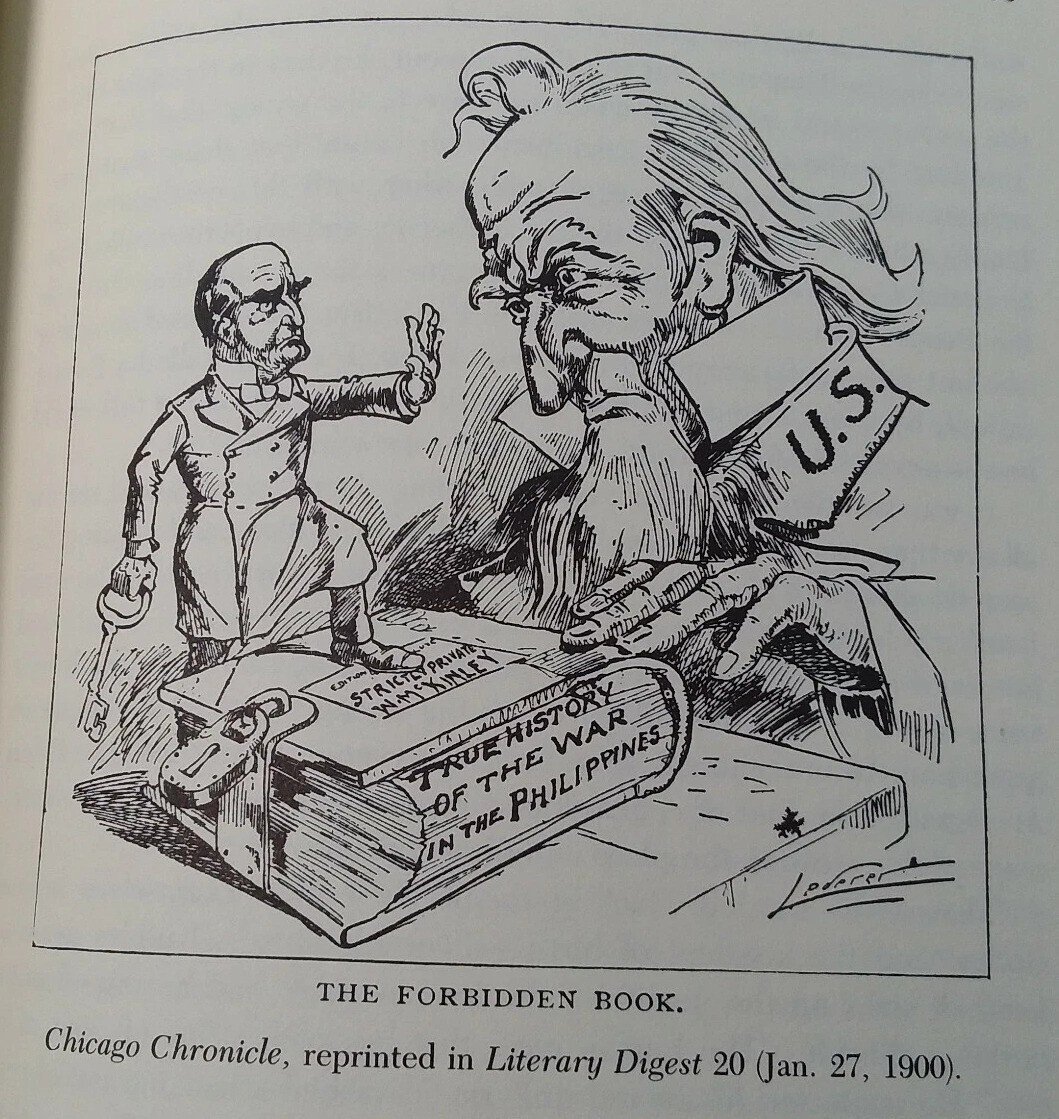
Have you ever heard of “The Forbidden Book”? It’s not your fault if you haven’t. It was “forbidden” for a reason. The book documents over 200 political cartoons used as propaganda to justify the Philippine-American War from 1899 to 1902, a dark and brutal part of our history not often taught in schools. The war resulted in the death of thousands of soldiers and as many as 200,000 Filipino civilians, though the estimate is closer to a million casualties accounting for the indigenous people of the Philippines.
Alongside recommended readings for every Filipino/a/x-American therapist, such as “Brown Skin, White Minds: Filipino-American Postcolonial Psychology” and “Clinical Interventions for Internalized Oppression,” this historical book is a must to better contextualize colonial mentality and racism in the Philippines and the United States. This article invites self-reflection. Understanding our history prevents repeating past mistakes. Our values shape how we accept or disrupt this world. After 400 years of Spanish and American colonization, un-learning is easier said than done.
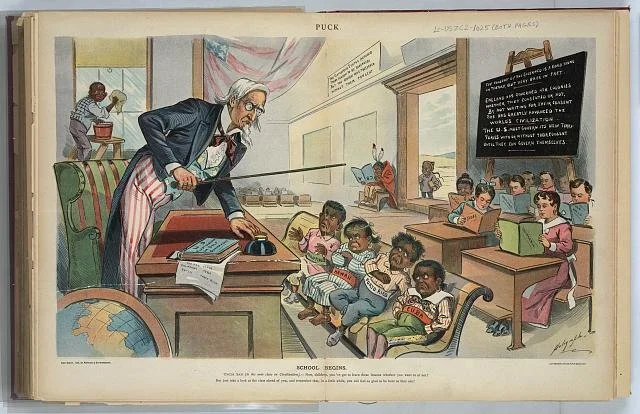
This 1899 print shows Uncle Sam as a teacher, standing behind a desk in front of his new students who are labeled “Cuba, Porto Rico, Hawaii, [and] Philippines”; they do not look happy to be there. At the rear of the classroom are students holding books labeled “California, Texas, New Mexico, Arizona, [and] Alaska”. At the far left, a Black boy cleans the windows, and in the background, a Native boy sits by himself, reading an upside-down book labeled “ABC”, and a Chinese boy stands just outside the door. A book on Uncle Sam's desk is titled “U.S. First Lessons in Self-Government.”
The Philippine-American War was a brutal continuation of the Philippine revolution against Spanish rule. This war began after the U.S. gained control of the Philippines from Spain following the Spanish-American War.
As the saying goes, “A picture is worth a thousand words” and this book shows plenty depicting not only Filipinos, but also other marginalized ethnicities from Puerto Rico, Hawaii, and Cuba as uncivilized and subservient.
When you take a look at the following images from this book and similar publications of that time, please reflect on the following questions:
Who is portrayed in the prints?
Who is the intended audience?
What emotions do they evoke in you?
Is it anger, surprise, curiosity, confusion, sadness, or something else entirely?
What somatic reactions, if any, do you notice in your body?
Do you see yourselves in these prints, or do you not?
What impact do the prints have on you?
The Four Levels of Colonial Mentality
Broken down into four levels, colonial mentality is considered a form of internalized oppression and is applied specifically to Filipinos and Filipino-Americans’ experience of oppression under Spanish and U.S. colonization: (1) denigration of the Filipino identity, (2) denigration of Filipino culture and physical characteristics, (3) discrimination against less-Westernized Filipino-Americans, and (4) tolerance and acceptance of historical and contemporary oppression of the Filipino ethnic group.
While Filipinos share lived experiences of colonial mentality, I am drawn to how each level can be represented by political illustrations from that time. In addition, we can see how the ripple effect of such propaganda and suppression can be seen in our community today.
(1) Denigration of the Filipino identity
We see the denigration of the Filipino identity today in how we feel shame in our culture, even in something as small as not wanting to eat traditional foods like adobo, balut, or lumpia at school or work for fear of mockery. We hide our food or grimace when others call it “weird” or “exotic.” We shrink ourselves to fit the dominant narrative out of survival, to assimilate into a culture that does not want to understand us.
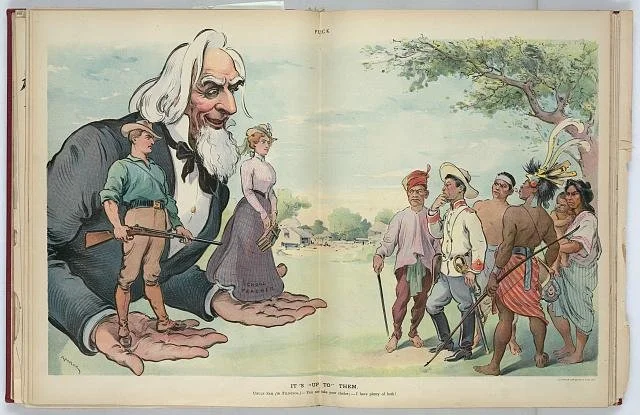
This 1901 illustration shows Uncle Sam offering on one hand a soldier and on the other a school teacher to a group of reluctant Filipinos, telling them that the choice is theirs. The Filipino identity is viewed as inferior and this false sense of choice at the hands of a foreign power calls for Filipinos to abandon our sense of identity as healers, revolutionaries, workers, warriors, and caregivers.
(2) Denigration of Filipino culture and physical characteristics
The denigration of Filipino culture and physical characteristics persists today in the popularity of whitening soaps, cherished for brightening skin and accompanied by childhood warnings against playing in the sun. Other examples of anti-Blackness include media whitewashing and mockery of "subservient" darker-skinned characters playing caretakers and housekeepers.
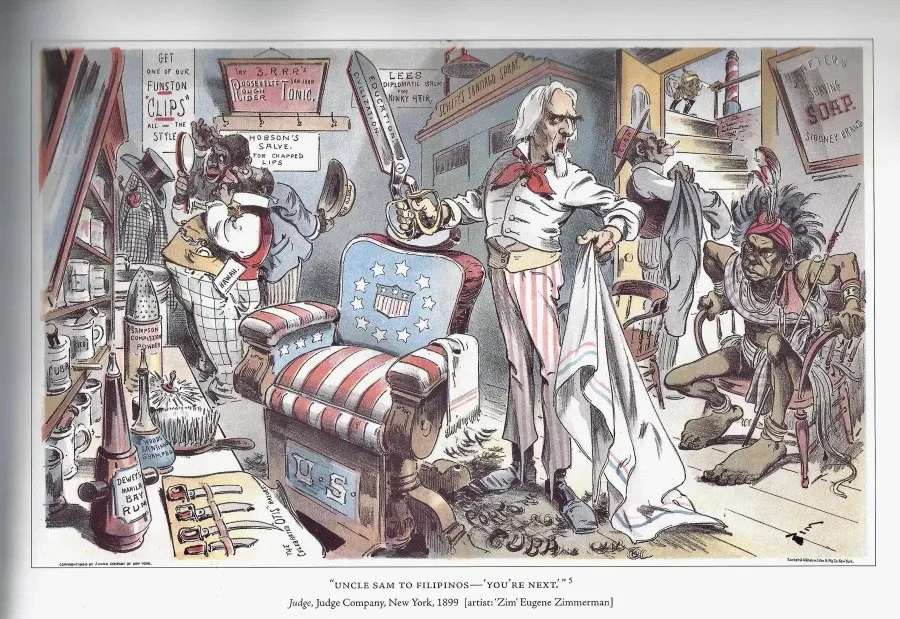
This 1899 political cartoon shows Uncle Sam giving the lands of Puerto Rico, Cuba, Hawaii, and the Philippines a haircut. The image shows the U.S. to be cleaning and grooming the lands that have gone under its possession with scissors labeled “education” and “civilization.” This image reflects the idea that Filipinos are barbaric savages that need to be educated and under control of the U.S. because we are not fit to govern ourselves.
(3) Discrimination against less-Westernized Filipino-Americans
One way we see discrimination against less-Westernized Filipino-Americans is through comedy, particularly when the Filipino accent itself is the punchline over narrative jokes. We also see it through shaming Filipinos less fluent in English (when there are over 175 indigenous Philippine languages) or diminishing the accomplishments, credentials, and education of Filipinos in the Philippines versus the U.S.
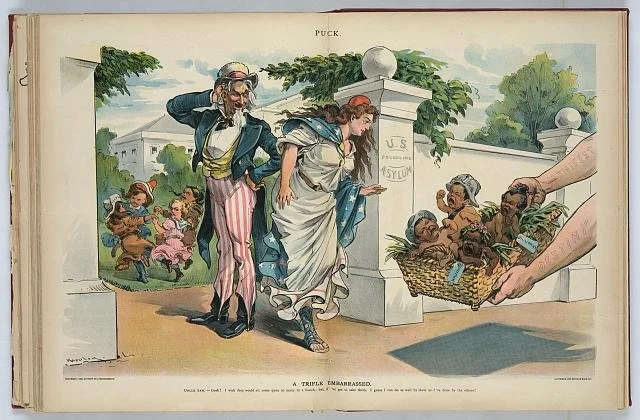
This 1898 print shows Uncle Sam and Columbia standing at the entrance to the “U.S. Foundling Asylum” as a basket of crying children labeled “Puerto Rico, Cuba, Hawaii, [and] Philippine” is presented to them by arms labeled “Manifest Destiny”. Within the walls of the asylum are four children labeled “Texas, New Mexico, Cal., [and] Alaska” playing together. The “less-Westernized Filipino-Americans” along with other ethnic identities are on the outer side of the wall and not welcome to play on the grass.
(4) Tolerance and acceptance of historical and contemporary oppression of the Filipino ethnic group.
Today, this tolerance and acceptance of our own oppressions shows up in Filipinos who denounce undocumented immigrants for not coming to the U.S. the “right way,” but also ignore the federal government’s blatant violence against all immigrants, documented or not.
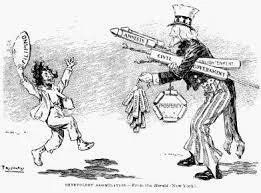
This cartoon from the 1900s depicts the outcomes that benevolent assimilation could bring to Filipinos. On the left hand side, the Filipino is depicted as excited to see Uncle Sam on the left. Uncle Sam is symbolically bringing “Civil Government,” “Prosperity,” “Enlightenment,” and “Amnesty. By showing excitement, this cartoon implies that colonization is a gift, despite its consequences of violence, disease, and famine, that we must tolerate and accept in order to experience true happiness in our lives.
FINAL REFLECTION
While these cartoons may be of their time, they are vivid examples of propaganda that have reinforced colonial mentality over decades.
Given the high rates of mental health distress and lower help-seeking among Filipinos, we must remember we're impacted by systems of oppression daily. Our survival is testament to our ancestors enduring genocide. There is bountiful strength in kapwa that colonizers desperately tried to mock and deceive. In times of division, we have greater power together in recognizing our shared struggles. Notably, David Fagen, a Black U.S. soldier, defected to the Filipino revolutionary army after witnessing the same racist atrocities during the Philippine-American War. For exploring solidarity and action, I recommend Dr. T's article, "Why Black History Month Matters to Filipinos & Asians".
As extra credit from “The Forbidden Book,” the Philippines is seen side-by-side with Puerto Rico, Hawaii, and Cuba. Lilla Watson, an aboriginal Australian artist, activist, and academic once said, “If you have come here to help me, you are wasting your time. But if you have come because your liberation is bound with mine, then let us work together.” With that, I ask for one more self-reflection: Why did Bad Bunny’s Super Bowl performance feel so familiar?
Acknowledgements: Dr. T for the guiding prompt. Stephanie Sajor for the conceptualization and editing.